
The Growth Was Already There. Pricing and Promotions Were Hiding It
DTC Vitamins & Supplements — Aligning Pricing Strategy with Customer Lifetime Value
Executive Snapshot
Client
DTC vitamins and supplements brand
Situation
Pricing, promotions, loyalty, and shipping policies were evolving without a clear understanding of their impact on customer lifetime value.
Insight
Customer cohort analysis revealed large differences in lifetime value across acquisition and promotional strategies.
Impact
Pricing and promotional strategy were redesigned around CLV.
A fast-growing direct-to-consumer brand in the vitamins and supplements category had built a loyal customer base through digital marketing, subscription offers, and frequent promotional campaigns.
The company had reached a scale where pricing decisions were beginning to have significant strategic consequences. Discounts, loyalty incentives, and shipping policies were being adjusted regularly to support growth and customer acquisition, but leadership lacked a clear framework for understanding how these choices affected long-term customer value.
As a result, many pricing-related decisions were being made in isolation. Promotions were evaluated primarily on their short-term revenue impact, loyalty incentives were introduced without a clear understanding of their economic effect, and shipping fees were adjusted largely based on competitive pressure.
The company was growing, but leadership wanted a clearer answer to an important question:
Were these pricing and promotional decisions actually improving the long-term economics of the business?
When Pricing Becomes a Customer Economics Problem
In many consumer businesses, pricing decisions are evaluated primarily through their impact on margins. But for a DTC brand built around repeat purchases and subscriptions, the more relevant metric is often customer lifetime value (CLV).
In this case, the company’s leadership suspected that some promotions were driving strong short-term sales but potentially attracting lower-value customers or encouraging purchasing behavior that reduced long-term profitability.
The challenge was that the data needed to answer these questions existed within the company’s transaction history, but it had not been analyzed in a way that connected pricing actions with customer lifetime behavior.
The CEO wanted to understand how pricing, promotions, and incentives were shaping the company’s customer base over time.
What the Data Revealed
Keenalytix analyzed the company’s transaction-level data, linking individual purchases to customer cohorts and purchase histories.
This made it possible to examine how different pricing mechanisms influenced customer behavior beyond the first transaction.
The analysis focused on several dimensions of the business:
- acquisition cohorts
- repeat purchase patterns
- promotional exposure
- loyalty program participation
- shipping fee structures
By tracking customer behavior across these variables, the analysis revealed meaningful differences in the long-term value generated by different types of promotions and incentives.
Some promotional strategies were highly effective at generating incremental demand and attracting customers who went on to become loyal repeat buyers. Others, however, primarily accelerated purchases that would likely have happened anyway or attracted customers who rarely returned after their initial order.
Similarly, the structure of shipping fees and loyalty incentives was influencing purchasing behavior in subtle but important ways. Certain combinations of discounts and incentives encouraged higher initial order values but did not necessarily translate into stronger long-term customer relationships.
These insights allowed leadership to see how different pricing mechanisms were shaping the composition and quality of the customer base, not just immediate sales.
From Promotional Activity to Promotional Strategy
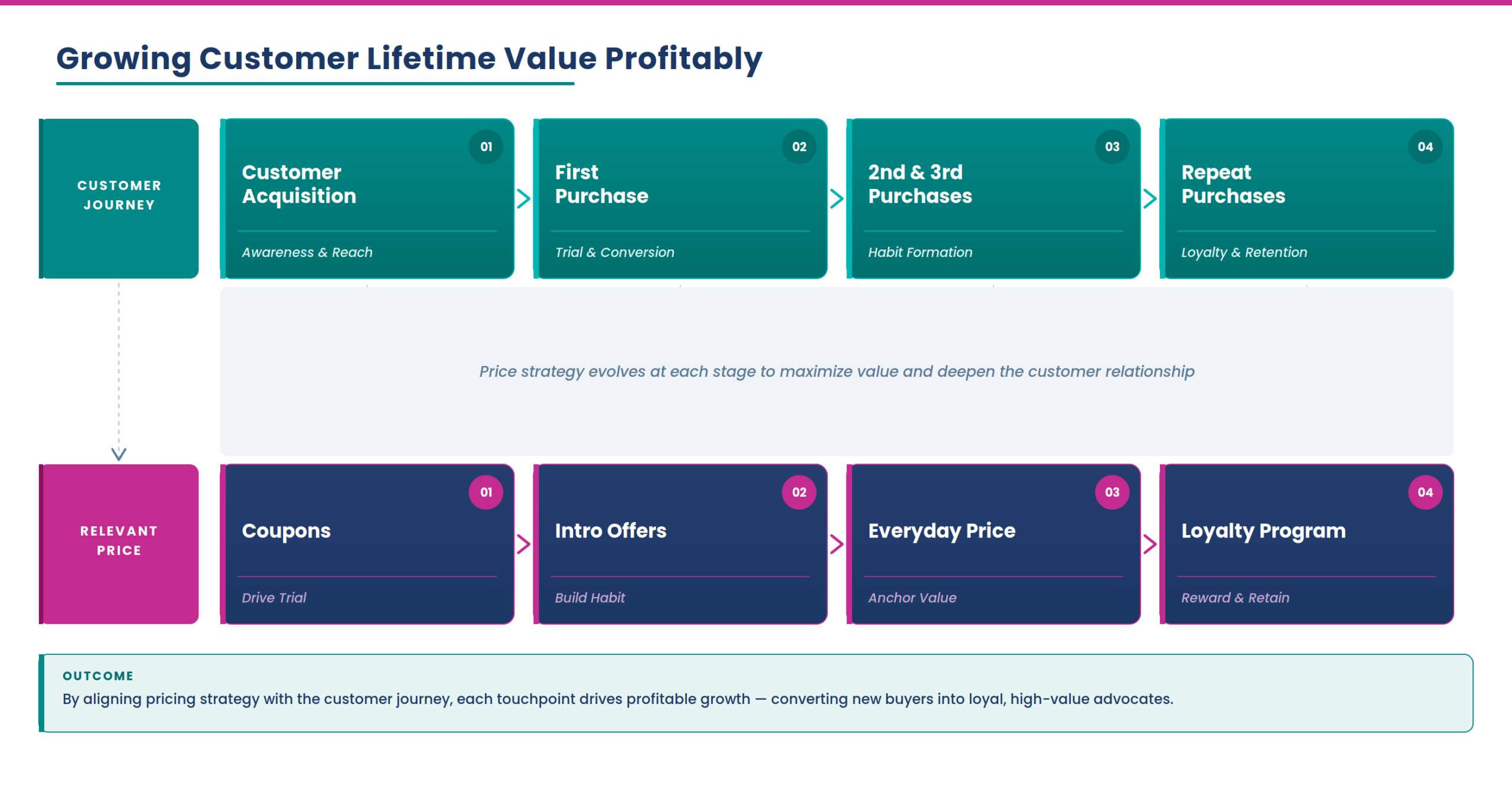
Rather than treating each promotion as a standalone marketing event, the analysis made it possible to evaluate pricing actions through the lens of customer lifetime value.
This perspective fundamentally changed how the company approached pricing decisions.
Promotions were redesigned to focus on attracting and retaining higher-value customers rather than maximizing short-term order volume. Loyalty incentives were adjusted to reinforce repeat purchasing behavior, and shipping policies were refined to better support profitable customer acquisition.
Because the analysis was grounded in actual customer purchasing patterns, leadership could evaluate these changes with greater confidence.
Pricing discussions within the organization shifted away from questions like “How much revenue will this promotion generate this weekend?” toward a broader question:How will this decision affect the long-term value of the customers we acquire?
The Results
Over time, this approach allowed the company to align its pricing, promotions, and customer incentives more closely with the economics of its business model.
Leadership gained a clearer understanding of how different promotional strategies affected both short-term revenue and long-term customer value. This made it possible to refine the company’s promotional calendar, adjust loyalty incentives, and optimize shipping policies in ways that supported sustainable growth.
Perhaps most importantly, pricing discussions within the company became more strategic. Decisions were no longer based solely on immediate sales performance but on a deeper understanding of how pricing actions influenced the company’s customer base over time.
A Strategic Advisory Relationship
What began as a pricing analysis engagement evolved into a broader advisory relationship between Keenalytix and the company’s leadership team. For several years, Keenalytix worked directly with the CEO to evaluate pricing, promotional, and customer incentive strategies through the lens of customer economics.
This ongoing collaboration helped the company integrate pricing decisions more closely with its long-term growth strategy.
Why This Case Matters
In many direct-to-consumer businesses, pricing, promotions, and customer incentives are managed as separate activities across marketing, operations, and finance.
But in reality, these mechanisms all shape the same outcome: the long-term value of the customer base. This case illustrates how transaction-level analysis can connect pricing decisions with customer lifetime value, allowing companies to design pricing and promotional strategies that support both growth and long-term profitability.
Related Case Studies
Before You Buy the Company, Understand the Customer Economics