
KEENALYTIX – PRICING DECISION SCIENCE
Pricing decisions that hold over time
Taking price is easy. Making pricing decisions that drive compounding profitable growth is not.
That’s why Keenalytix has developed Pricing Decision Science, a system to take uncertainty and risk out of your pricing, promotion and other commercial decisions. Instead of a series of reactive and unproductive calls, every decision becomes a winning one.
BUILT FOR
C-Suite, VP, Director
FUNCTIONS
Finance, Marketing, Operations, Product Management
OUTCOME
100-300+bps in gross margin with no volume loss, consistently
COMPANIES THAT CALL US
When a pricing decision feels too risky
Three different situations. The same underlying problem: the absence of a system that makes decisions feel too risky and uncertain.
DECISION PROBLEM
We don’t know what to do
The next pricing decision is near. The stakes are high. The downside is unclear. The company wants confidence and doesn’t have it yet.
LEAKAGE PROBLEM
We think we broke something
Margins are trending the wrong way and pricing doesn’t seem to help. Time to put out the fire and reset pricing strategy and execution.
SIGNAL PROBLEM
We don’t know what’s happening
A recent price increase didn’t work as planned. The outcome is not fully understood, and the next decision is already arriving.
WHAT’S AT RISK
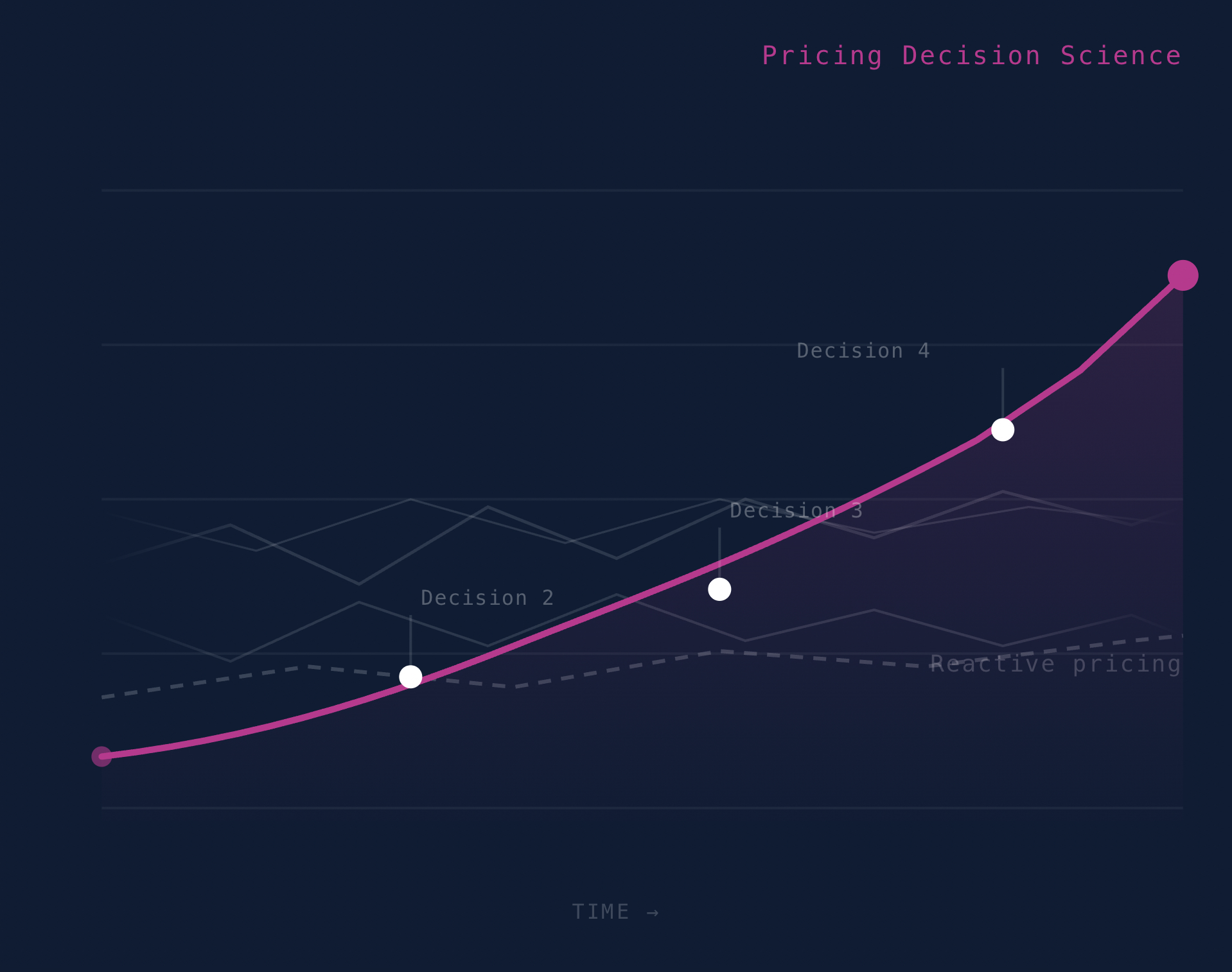
Bad pricing decisions don’t fail immediately. They accumulate.
The cost of pricing indiscipline isn’t a single bad call. It’s the slow loss of control over your own pricing logic, leading to millions of dollars of revenue and profit erosion.
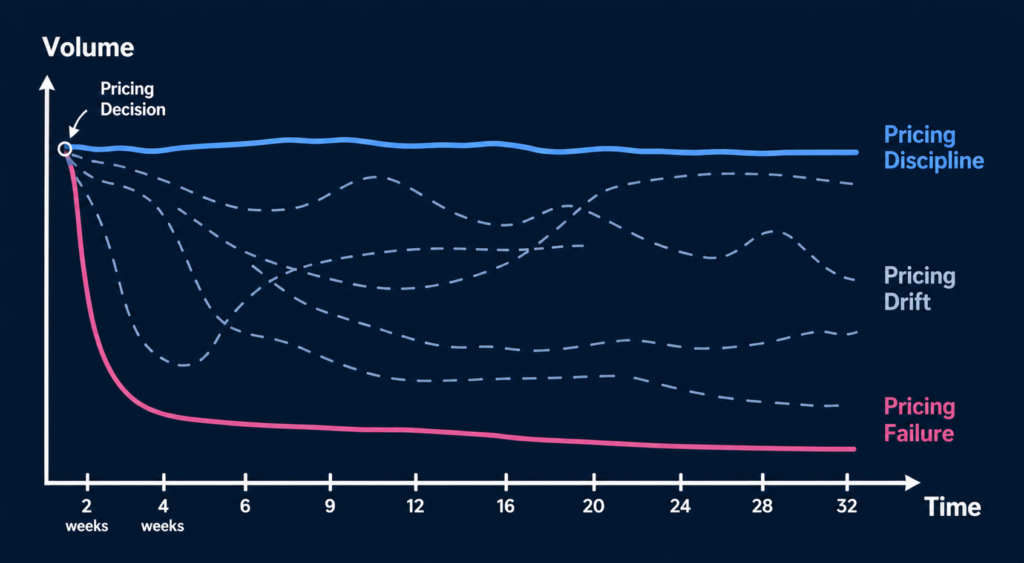
Margins erode.
Discount becomes the default. The everyday price loses its ability to anchor.
Promotions get harder to unwind.
Customers value the discount, not the product. Retracting it costs more than running it ever did.
Customers adapt in ways you can’t reverse.
Behavior gets baked in. The brand’s commercial logic moves out of your hands.
Over time, the business loses control of its pricing logic.
THE SYSTEM
Decisions that hold come from structure, not instinct.
Three pillars. Three phases. The asymmetry is intentional: the best pricing decisions are the ones that are well-prepared. Most of the work happens before and during the decision, not after. Most companies have fragments, very few have a system.
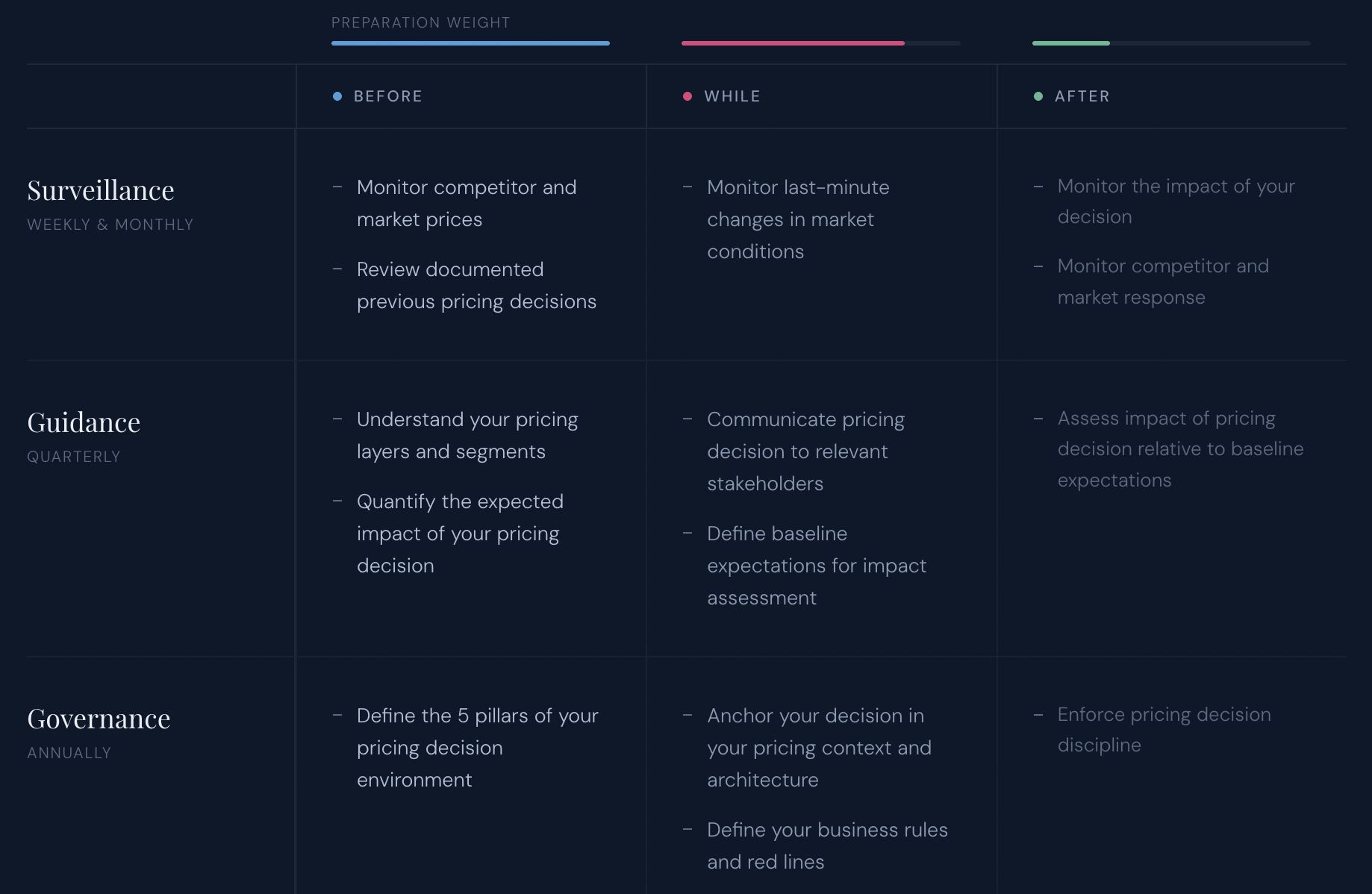
Discipline over multiple cycles = compounding pricing decisions.
The system improves with every decision made inside it.
THE SCIENCE
Pricing decisions are classification problems under uncertainty.
Our proprietary Pricing Decision Science system blends advanced analytics and qualified judgement to give the right decision. Consistently.
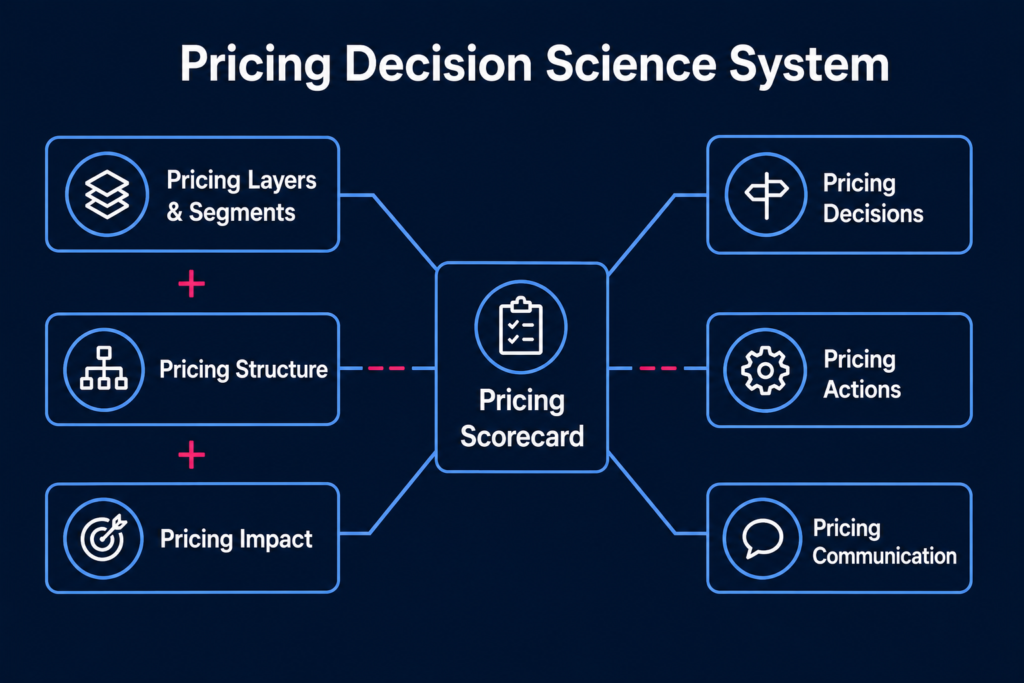
Anchored in your business reality.
We start with your business context, strategy and constraints, then design your pricing decision system accordingly.
Powered by data and analytics.
Predictive price elasticity. Segmentation models. Optimization algorithms. All running in the background…and always constrained by your business rules.
Driven by your decision needs.
The system gives you actual pricing decisions and actions you can implement immediately.
WORKING WITH US
From reactive decisions
to disciplined systems.
Three ways to engage. The first answers a question. The second builds the structure. The third makes it durable.
2-12 WEEKS
Independent Pricing Review
Know what your pricing actually delivers.
Get an impartial and objective measurement of your pricing effectiveness. Improve your next pricing decision.
YOU LEAVE WITH
- A report card, based on your data
- A clear outcome on your decision
- A recommendation for your next move
8-12 WEEKS
Pricing Decision Science
Ace your next pricing decision. Build the structure for the following ones.
Two workstreams. Short term, we design your next pricing decision, based on advanced analytics. Long term, we build the system that will make it all compound.
YOU LEAVE WITH
- A fully-designed pricing decision, ready for implementation
- The Pricing Decision Science system, adapted to your business and operational
- Improved internal pricing capabilities
ONGOING
Pricing Decision Partner
Improve decisions over time. Fine-tune the decision-making system.
We support your team throughout the pricing cycle, from target-setting to final read. Until you’re ready to do it on your own.
YOU LEAVE WITH
- Live and ongoing pricing decision support, on demand
- Post-decision pricing effectiveness measurement
- Knowledge transfer to build in-house pricing capabilities
PROOF
Pricing Decision Science in action. And it works.
Across industries and engagements, the same process, the same results: clear, confident and impactful pricing decisions, made systematically and deliberately.
RESTAURANTS
How Decision Science Turned a Coffee Chain From Follower to Leader
From losing 12% in traffic after a bad pricing decision to consistently leading its category and pleasing its shareholders. Achieved over 36 months by combining advanced analytics with structured decision-making.
APPAREL
The Price Increase Worked. The Problem Was Everything Around It.
Volume was down 15% after a price increase. Everyone was ready for deep markdowns. But pricing had nothing to do with it and volume eventually recovered. A good example of why you should track your pricing decisions over time.
DTC
The Growth Was Already There. Pricing and Promotions Were Hiding It.
Across-the-board price increases on one hand. Overly aggressive promotions on the other. A poorly designed loyalty program in the middle, and shipping fees waived half of the time. The business was growing despite itself. We changed that.
“Fred’s work was instrumental in guiding two company wide price increases. Both times, profits grew as expected without negative impact to customer traffic. The benefit flowed directly to the bottom line.” (VP Strategy, Fast Casual)
ABOUT
Built by Fred Puech
PhD economist. Pricing decision scientist. Advisor to executive teams across consumer brands, B2B manufacturing and distribution, and private equity.
Over the past two decades, Fred has helped dozens of leadership teams navigate price increases, promotional complexity, and high-stakes monetization decisions, turning pricing from a reactive function into an operating discipline.
What clients hire him for:
- When a price increase backfired
- When promotions start eroding margin
- When leadership wants confidence before making the call
- When a strategic change in direction is needed

Fred Puech, PhD
Pricing Decision Scientist
Keenalytix Founder
If pricing decisions matter, they need to hold. Most don’t.
Bring one decision you’re sitting on. We’ll run it through the Pricing Decision Science framework together. No decks. No pitch. A working session that ends with a sharper call than the one you walked in with.
FORMAT
60-minute working session, online, free.
PREP
Bring one decision (pricing or promo) and the data you have on it. Even if you’re just getting started.
AFTER
You will walk out of the call with more clarity about your decision and a plan to make it happen.
Pricing Decisions
My newsletter, where I provide independent thinking on pricing, commercial decisions, and the economics behind them.