
The Price Increase Worked. The Problem Was Everything Around It
DTC Apparel Brand — Diagnosing the Impact of a Price Increase
Executive Snapshot
Client
DTC apparel brand
Situation
A price increase appeared to cause a drop in conversion and sales.
Insight
Transaction-level analysis showed the decline was largely driven by product mix shifts rather than broad price sensitivity.
Impact
Pricing adjustments were targeted at specific product categories instead of reversing the entire increase.
A rapidly growing direct-to-consumer apparel brand had recently implemented a series of price increases across parts of its product assortment. The decision was driven by rising costs and a desire to improve margins while maintaining the brand’s premium positioning.
Shortly after the changes were implemented, performance indicators began to raise concerns. Conversion rates declined, certain product categories slowed significantly, and overall revenue growth softened.
Leadership faced a familiar but difficult question: Had the company pushed prices too far?
Without a clear analytical framework to interpret the results, internal explanations quickly diverged. Some believed the brand had reached its pricing limits. Others suspected external factors such as seasonal demand fluctuations, marketing performance, or competitive pressure.
Before reversing the price changes, the company wanted to understand what had actually happened.
The Difficulty of Interpreting Pricing Outcomes
Price increases rarely affect all products or customers in the same way. In multi-product consumer businesses, overall performance metrics can mask very different patterns occurring within the product portfolio.
A decline in conversion or revenue following a price increase may reflect genuine customer price sensitivity. But it may also result from changes in product mix, promotional activity, marketing traffic, or shifts in purchasing behavior across different customer segments.
In this case, leadership had access to large amounts of transactional data, but the organization lacked a structured way to isolate the true drivers of the observed performance changes.
What the Data Revealed
Keenalytix analyzed the company’s transaction-level sales data across products, price points, and customer purchasing patterns.
Rather than evaluating the price increase through high-level metrics alone, the analysis decomposed performance across several dimensions of the business:
- individual product categories
- price tiers within the assortment
- customer purchasing behavior
- order composition and basket structure
This deeper analysis revealed that the apparent performance deterioration following the price increase was not uniform across the business.
Some products experienced measurable demand sensitivity after the price adjustments, but many others showed little change in purchasing behavior. In several categories, customers continued buying at similar volumes despite higher prices.
The headline decline in performance was largely driven by changes in product mix and purchasing patterns, rather than a broad loss of demand caused by the price increases themselves.
Certain items that had historically contributed a large share of sales were more sensitive to pricing changes than others, and their performance shifts disproportionately influenced top-line metrics. Once these mix effects were isolated, the underlying picture became much clearer.
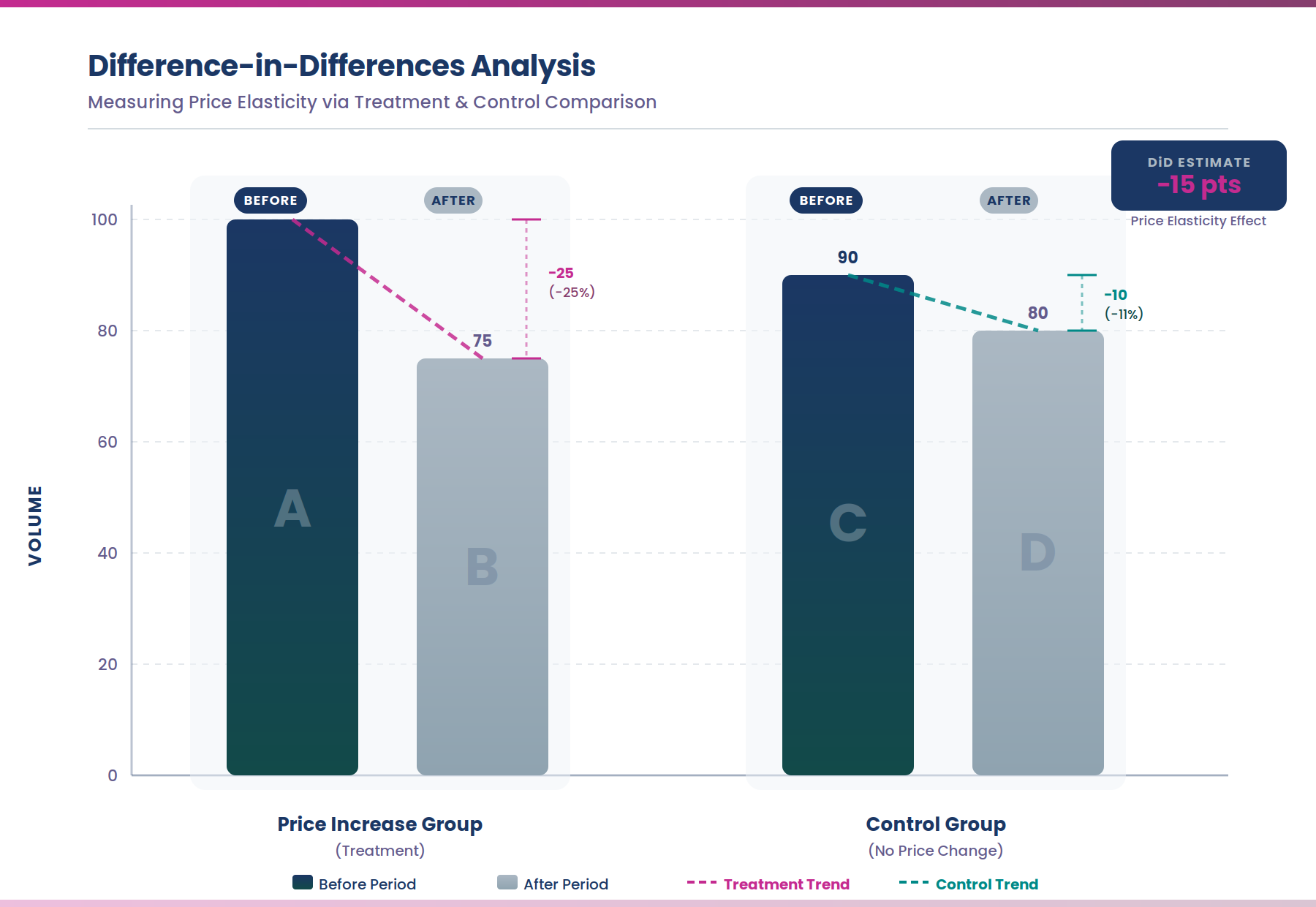
From Uncertainty to Decision Clarity
The analysis helped leadership move beyond speculation about whether the price increase had “worked” or “failed.”
Instead, the company could see precisely which products and price tiers were driving the observed changes in performance.
This made it possible to refine pricing decisions at a much more granular level. Rather than reversing price increases across the entire product portfolio, the company could adjust specific categories where demand proved more sensitive while maintaining pricing in areas where customers showed greater willingness to pay.
The analysis also provided a framework for evaluating future pricing decisions. Instead of relying on high-level performance indicators, the company began monitoring price performance across product segments and purchasing patterns to better understand how different parts of the assortment responded to pricing changes.
A Lasting Analytical Capability
Although the engagement was structured as a project, the analytical framework developed during the work became an ongoing tool for the business.
The company integrated the analytical models and monitoring tools into its internal processes, allowing leadership to evaluate future pricing changes with far greater clarity.
What had initially been a reactive investigation into a potentially failed price increase ultimately became a capability that helped the company approach pricing decisions more confidently going forward.
Why This Case Matters
When companies implement price increases, the results are often interpreted through a small number of high-level metrics such as conversion rate or overall sales.
But these metrics rarely tell the full story.
Transaction-level analysis can reveal how different products, price tiers, and customer behaviors contribute to overall performance. Without this level of insight, organizations risk reversing pricing decisions based on incomplete information. This case illustrates how deeper analytical visibility can transform pricing discussions from speculation into evidence-based decision making.
Related Case Studies
How Pricing Discipline Turned a Coffee Chain From Follower to Leader