
How Pricing Discipline Turned a Coffee Chain From Follower to Leader
Multi-Unit Coffee Chain — Building a Structured Pricing Capability
Executive Snapshot
Client
Multi-unit coffee chain
Situation
Pricing decisions were reactive and inconsistent across stores.
Insight
Most menu items had more pricing power than leadership believed.
Impact
Store tiering and pricing monitoring restored pricing discipline.
A large quick-service restaurant chain specializing in coffee and breakfast had built a strong brand and a loyal customer base across hundreds of locations. Despite healthy traffic and steady growth, pricing had gradually become a source of operational friction and commercial uncertainty.
Like many restaurant chains, the company had historically approached pricing in a reactive way. Menu prices were often adjusted in response to cost pressure, competitive moves, or short-term performance concerns. Individual price changes were made with good intentions, but without a clear analytical framework for understanding their impact.
Over time, this approach created instability. Some price moves succeeded, others did not, and leadership lacked a reliable way to understand why.
A Business That Believed It Had a Pricing Power Problem
When Keenalytix first became involved, leadership believed the company faced a straightforward challenge: the brand lacked pricing power.
Traffic had weakened in certain markets following price increases, and management suspected that the chain had become less competitive relative to other coffee and quick-service options. The natural response was caution. Pricing decisions became increasingly conservative, and the organization grew hesitant to make further adjustments.
The risk was clear. If the business truly lacked pricing power, aggressive price moves could damage traffic. But if the diagnosis was wrong, the company could be leaving significant margin opportunity on the table.
The key question was simple but difficult to answer with confidence:
Was the company genuinely constrained by customer price sensitivity, or were other factors distorting performance?
What the Data Actually Revealed
Keenalytix approached the question by analyzing transaction-level data across the chain’s menu, locations, and customer purchasing patterns.
Rather than looking only at headline metrics such as average ticket or overall traffic, the analysis decomposed performance across multiple dimensions of the business:
- product categories
- price tiers within the menu
- store-level performance differences
- purchasing patterns across time and location
This deeper view revealed something leadership had not expected.
The vast majority of the menu was not highly price sensitive. In fact, many core items had significantly more pricing flexibility than the organization believed.
The apparent performance issues following price increases were not primarily driven by customer resistance. Instead, they were the result of inconsistent pricing structures across stores and menu items, which created localized competitiveness issues and operational noise.
Some stores were priced appropriately for their market conditions, while others were misaligned with local demand and competitive environments. These inconsistencies made it difficult for leadership to interpret the impact of pricing changes at a system level.
What looked like a company-wide pricing power problem was, in reality, a lack of structured pricing architecture and performance monitoring.
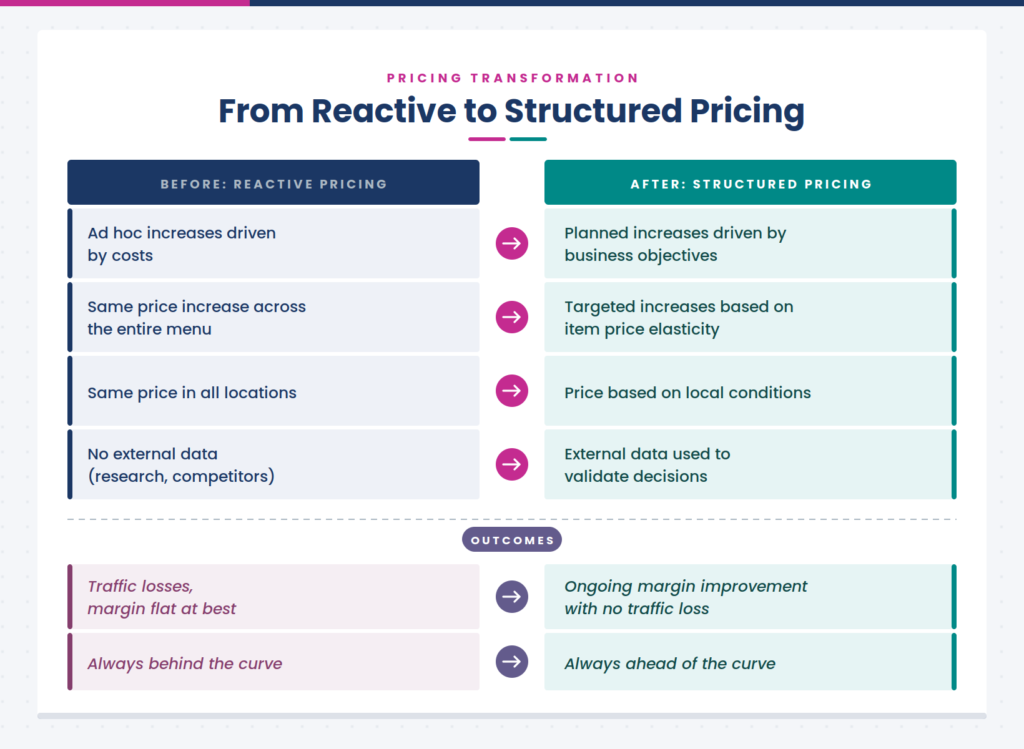
Moving from Reactive Pricing to Structured Pricing
The goal was not simply to recommend new prices. The objective was to build a system that allowed the organization to make pricing decisions with clarity and confidence.
The first step was to introduce store tiering, grouping locations based on their competitive and demand environments. This allowed pricing decisions to reflect meaningful differences between markets rather than forcing a single national approach.
The tiering system started with a small number of store clusters and was gradually expanded as the organization gained experience using it. This created a more structured framework for price adjustments while maintaining operational simplicity.
At the same time, Keenalytix implemented analytical tools that allowed leadership to track price performance more clearly. These tools made it possible to distinguish between genuine pricing effects and other factors influencing traffic or revenue.
Instead of interpreting pricing outcomes through anecdotal evidence or isolated store results, leadership could now evaluate changes across the entire system with a much clearer understanding of cause and effect.
The Results
Over time, this shift transformed how the organization approached pricing.
Traffic stabilized and began to recover within roughly eighteen months as pricing became more consistent and better aligned with local market conditions. At the same time, the company regained the confidence to make pricing decisions proactively rather than reactively.
Perhaps more importantly, pricing discussions within the organization became more disciplined. Leadership could evaluate price changes using structured data rather than relying on assumptions about customer behavior.
This change turned pricing into a manageable commercial lever rather than a recurring source of uncertainty.
A Long-Term Partnership
What began as a pricing analytics engagement ultimately evolved into an ongoing advisory relationship. Keenalytix has now worked with the company for several years, supporting pricing decisions through continuous analysis and performance monitoring.
The organization’s pricing capability today looks very different from where it started. Decisions are made within a structured framework, supported by transaction-level analytics and clear performance visibility.
The business moved from reacting to pricing outcomes to deliberately managing them.
Why This Case Matters
Many multi-unit restaurant chains assume that weak performance following price changes means customers are highly price sensitive.
In reality, the problem is often more structural.
Without a clear analytical framework, pricing signals become difficult to interpret, and organizations lose confidence in one of their most powerful commercial tools.
This case illustrates how deep transactional analysis combined with structured decision support can turn pricing from a reactive activity into a disciplined operating capability.
Related Case Studies
The Price Increase Worked. The Problem Was Everything Around It.