

Why Every Commercial Decision Starts With Aristotle
How a 2,400-year-old distinction between analysis and synthesis still explains why so many commercial decisions fail.
The paradox of modern analytics
We’ve all heard the cliched expression: data is the new oil. Over the last couple of decades, businesses took that expression to heart and invested billions of dollars in data, analytics and, more recently, artificial intelligence. Everyone now has access to more dashboards than they can count, statistical models are more sophisticated than ever, and now AI can do all this for you during the time it takes you to go to the coffee machine and come back.
On the face of it, this is a great development. Decisions are now supported by evidence rather than “gut feel” (or worse, the dreaded “because we’ve always done it this way”). Businesses are now more analytical than ever.
Then why are so many commercial decisions mediocre, when they’re not entirely wrong? The price increase that killed volume (and margins, somehow). The promotion that failed to drive incremental demand. Competitors getting into price wars without knowing why or who started it.
Why does this keep happening, in this golden age of data analytics, with so much information available? There is probably more than a single answer to this question but a good starting point is this: we don’t really know what “analyzing” means and we conflate it too often with the decision itself.
So let’s go back 24 centuries, to the very person who “invented” the word.
What Aristotle meant by analysis
Like many good things in modern life, the word analysis comes from Ancient Greece. It first appeared in Aristotle’s writings on logic. The term itself means breaking something complex into its essential components in order to understand how those components relate to one another. The two components are equally important here: first, you identify the components, then you figure out the relationship between them. It is a disciplined way of tackling complexity before attempting to act upon it.
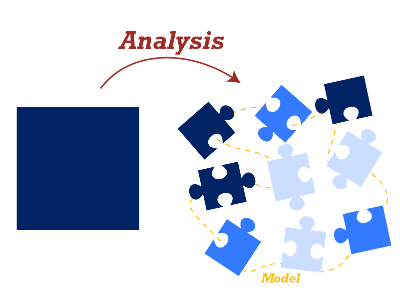
That definition has aged remarkably well. Think of what modern analytics does. Faced with a business problem, we collect information, identify the relevant variables, study their interactions and build models that help explain what is happening, and even predict what will happen next. Whether those models rely on basic spreadsheet calculations, econometrics or machine learning is irrelevant, or at least secondary. The underlying intellectual process has changed very little since Aristotle first described it.
Analysis, however, is not the end of the process (and was never meant to be so).
Analysis and synthesis
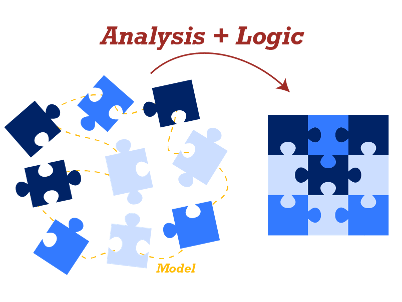
Aristotle also distinguished analysis from synthesis. The origin of the word synthesis itself gives us the clue: it literally means putting the pieces back together. Far from being opposites, analysis and synthesis are simply the two steps of an overarching process: thinking and acting logically.
Once a problem has been broken apart and understood (analysis), someone still needs to put the pieces back together (synthesis). Evidence needs to become judgement. Insights need to lead to a coherent course of action.
This is where many organizations (and, to be frank, individuals) struggle.
Analysis has become increasingly sophisticated and abundant; some say it has even been commoditized by AI (I disagree, because I think it sells analytics short, but that’s a debate for another day). Synthesis didn’t follow. The reason is simple: we found tools (computers) to elevate our analytical capacities and automate most of it; but synthesis, and the decision-making process that follows it, is still very much a human, “manual” task. And as such, it remains highly dependent on circumstances: time pressure, competing incentives, internal politics, and individual egos of course.
The consequences are particularly visible in pricing.
Where commercial decisions go wrong
Very few pricing decisions fail because the analysis that preceded them was technically incorrect. More often, they fail because the organization asked the wrong question, ignored part of the evidence, reacted to short-term events, or implemented the decision inconsistently. Those failures are not statistical. They are organizational.
Looking back over twenty years of pricing work, I have become convinced that the quality of a commercial decision depends more on the questions asked before the analysis even begins than on the analysis itself. If you follow me along and read more of my articles (and I hope you will!), you will often see me say: start with the why. If you don’t know why you’re taking that price increase or why you’re launching that new promotional campaign, the chances of not getting the results you are expecting are surprisingly high.
Artificial intelligence somehow makes them even higher, not lower.
Why AI makes synthesis more important than ever
AI lowers the cost of producing analyses; at current trends, it will make this cost virtually null very soon. In a matter of years, we collectively went from not having enough information, to not being able to process it well enough (or fast enough), to being overflooded with analytical “insights” (I use air quotes here because most analytical output these is, in fact, not that insighful).
However, AI does not remove the need to synthesize that mass of information and, eventually, decide. Worse, it has somehow created a form of “analysis paralysis”: too much data, too much information for our brains to process, in too little time. Under the appearance of making everything easier, I think that AI has actually made life harder for decision-makers.
It doesn’t mean we should go back to the “good old days” of deciding without data. The push for more information and better analytics had, and still has, a perfectly valid foundation: one makes better decision when better informed. No, what is needed is a better process to take all that mass of information and turn it into profitable decisions.
That has changed the way I personally think about pricing. For most of my career, I was “the analytics guy”. I built hundreds of pricing models, calculated millions of price elasticities, crunched terabytes of data. I still do. But now, I emphasize what comes after that job is done: how to make sense of it, what it means for the business and for the decision in front of us.
More importantly, I’ve becoming convinced that the organizations that “win” at pricing decisions are the ones that have a built a systematic way to decide with consistency and discipline. I no longer see pricing as a technical discipline whose purpose is to calculate the correct number. I see it as one of the clearest expressions of how an organization makes commercial decisions. Every pricing decision reflects the quality of the questions that preceded it, the discipline of the process that produced it and the consistency with which it is executed over time.