
Case studies / B2B
Building products manufacturing · 8 weeks
220 Ways to Price the Same Product
Building Products Manufacturer: Simplifying a Cascading Price System
- Client
- Manufacturer and distributor of building products, selling through several brands to contractors, fabricators and large corporate accounts
- Situation
- A cost-plus pricing system with cascading price levels, discount codes, contracts and manual overrides
- Insight
- The system’s logic was sound, but its complexity meant only 56% of sales went through regular pricing, and the same item could sell at 15 to 20 different prices
- Impact
- Low-risk pricing opportunities worth roughly 1.5% to 5% of revenue identified, concentrated in a few brands and in smaller accounts
- Engagement
- 8 weeks of transaction-level analysis of a full year of US sales: about 26,000 products and 35,000 customers
Executive Snapshot
The company sold building products under several brands, from standard hardware bought mostly by small contractors to custom products for large commercial accounts. Pricing was entirely cost-plus: target margins set by brand and category, with discounts earned through customer spend.
The principle was sound. Customers qualified for better price levels as they bought more, and large customers paid less than small ones. Leadership wanted to know whether that system was still delivering the margins it was designed for, and where the short-term opportunities were before a broader redesign.
A System That Grew in Layers
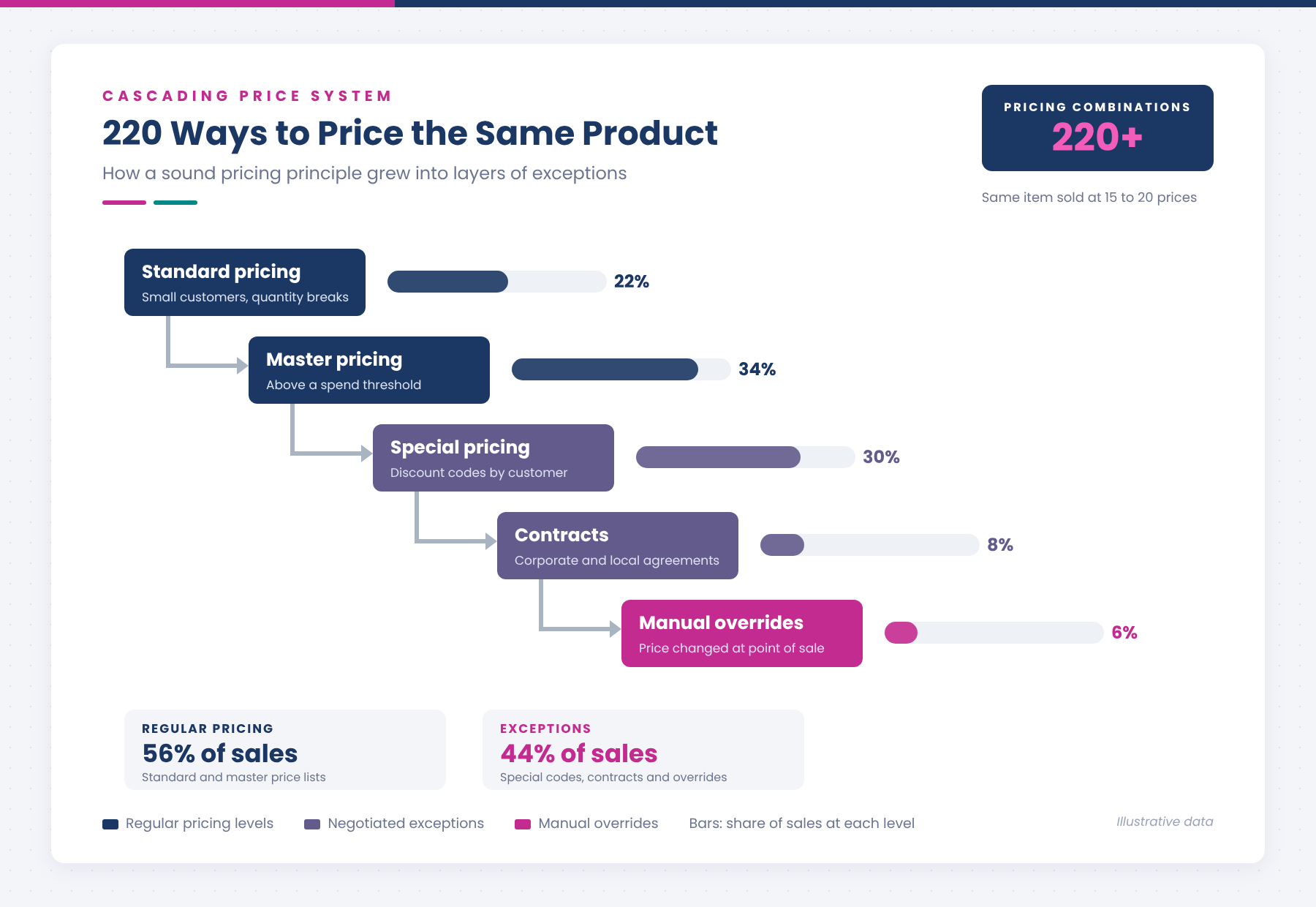
Over time, the pricing system had grown into a cascade. Customers started on standard pricing, moved to a master price list above a spend threshold, and then could receive special discount codes, corporate or local contracts, or manual overrides at the point of sale. The system always gave each customer the lowest price it qualified for.
In a year of orders, Keenalytix found more than 220 distinct pricing combinations, most of them used only once or twice. Each layer made sense when it was added. Together, they made it very hard to see what price any customer was actually paying, or why.
What the Data Revealed
Keenalytix analyzed every transaction across:
- pricing source (regular, special, contract, override)
- customer quintiles by annual spend
- product quintiles by annual sales
- brand and product category
The overall pattern followed best practice: larger customers paid less and top-selling products carried lower margins. But the averages hid wide variation. Only 56% of sales came from regular pricing. A large number of customers paid less than the corporate contract price, which should have been the floor. Price variance was higher among small customers than large ones, the opposite of what discipline would produce. And manual overrides were used almost entirely to lower prices.
The brands also differed sharply. Some were sold more than 90% through regular pricing, mostly to small and mid-sized customers. Others ran mainly on special pricing and contracts, and in custom products more than 80% of sales came from manual overrides.
Knowing Where to Act, and Where Not To
That difference shaped the recommendations. The largest and lowest-risk opportunity was a targeted price increase on the brands sold mainly through regular pricing to smaller customers, who have less negotiating power and represent less risk if they leave. In the brands dominated by large accounts and contracts, the opportunity was limited and Keenalytix said so.
For custom products, where overrides were the norm, the analysis concluded there was no reliable short-term opportunity at all. The right next step there was not a price change but a review of the pricing model itself.
The Results
The first phase identified pricing opportunities worth roughly 1.5% to 5% of revenue, with very limited volume at risk, and the company implemented the quick wins from the analysis. It also received the analytical framework and dashboards, shared with its internal analytics team, and a plan for the next phase: simplifying the price system and replacing spend-based price levels with a value-based segmentation of customers and products.