
Your Customers Don’t Care About Your Org Chart
I’ve lost count of the number of times I’ve encountered this pattern in my 20 years of advising businesses. It typically looks like this. The pricing team, after careful analyses and calibration, pushes a 2.183% price increase; they really insist on the 0.003% because they love precision and it took them ten meetings to get to that number. The move includes the first increase on product X in two years.
Two weeks later, product X is front-and-center in a promotional campaign, part of a “2 for $Y”. At that point, the price increase has already disappeared. So much for that increased EBITDA the Pricing team promised to the CFO. Digital coupons launched a week after the promo will only add insult to injury. Then the regional discount decided by the Southeast Area Manager (“because these guys need help”) will bury it for good.
And in the middle of this uncoordinated mess? The customer, wondering why product X went from $4.79 to $4.99, then to 2-for-$8, then to $3.99 in the app. Or $4.29 if they happen to live in the Southeast. At that point, they don’t even know if they should buy now in case the price goes back up or wait a bit in case another “deal” is coming their way. In the meantime, they buy product Z, product X’s main competitor, because its price seems fair and transparent.
This sad situation conflates two issues:
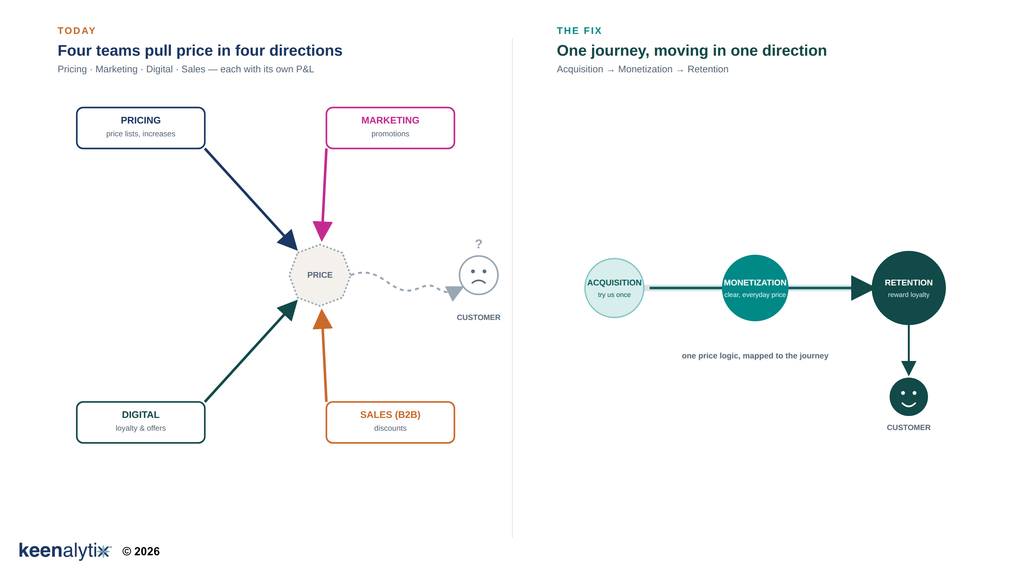
- Several teams are “allowed” to touch price to achieve their objectives. The problem is of course that their objectives are not aligned and can sometimes be contradictory: Pricing typically cares about profitability, Marketing about volume, Digital about penetration, Sales about, well, sales.
- These teams, even though they work for the same company, do not work in a coordinated fashion. As a result, they end up walking on each other’s feet or just pulling in opposite direction altogether.
Below, we will explore in more details why this is such a problem for companies. I will also offer a “natural” solution, based on the customer journey rather than forced collaboration.
The scourge of uncoordinated pricing decisions
Let me start by clarifying two important elements:
- There is nothing wrong with a company having multiple prices for the same product. Better yet, this is what most in the industry would consider “best practice”. A core pillar of good pricing is segmentation, i.e. the ability to price as close as possible to the customer’s willingness to pay and value perception, which is of course different for each of us.
- There is nothing wrong with having different teams managing those multiple prices either. A key learning of decades of management science is that an organization is better off letting each team, with its own specialized knowledge of its field, work and decide on their own rather than centralizing all decisions. To put it differently: having the Pricing team decide on a promotion or the Marketing team decide on a price increase would leave the company even worse off.
What is the issue then? Well, in this case, the main problem is that the lack of coordination between teams costs the company money. Lots of it. My example above is not merely illustrative. It’s what actually happens in many companies, even large corporations, on an ongoing basis. I’m sure you’ve encountered a similar situation at least once in the last quarter (if you did, comment on the article or respond to the emailed newsletter, I love good pricing anecdotes!). The problem itself is not new and has, in fact, been the subject of extensive academic research over the last few decades.
Operations Research tackled it first and demonstrated that, in the presence of incomplete information, inconsistent time intervals, or simply “local” goal-seeking, the sum of the outcomes is suboptimal in aggregate. Let’s translate that into plain English: if teams don’t know what the others are doing, have their own decision calendar and only focus on their own P&L, the company’s financial results are not maximized. The previous sentence described just another day at the office in most businesses, which shows the scope of the problem.
Systems theory and management science is another field that studied this issue in depth. Some of you may have already detected some familiarity between what I’m describing and Russell Ackoff’s body of work. It’s no accident and again, the problem is not new. However, it clearly hasn’t been solved and, in the specific case of pricing decisions, it proves very costly.
Next, I’d like to offer a solution. I’ve seen it implemented a few times, although not enough unfortunately. It works and is relatively easy to implement because it doesn’t require a major corporate reorganization or yet another “cross-functional” committee. Let’s dive in.
Use the customer journey to guide your commercial decisions
Here is what I think the real problem is: we’re asking the wrong question. We keep wondering who should be in charge of maintaining list prices or who should be running promotions. This is still very much an inward-looking way of making decisions.
It forgets the most important “stakeholder” in any commercial decision, but especially the ones involving a price move: the customer. As the title of this piece made explicit, your customer does not care about any of what I have described so far. The centralization vs. decentralization debate, the suboptimality of divisional P&L’s, Ackoff’s views on coordinating decisions; these are all problems that the firm needs to solve internally, not in front of its customers. But when it translates into multiple uncoordinated pricing moves, it’s exactly what happens, and that is what costs the business volume, revenue and margins at once.
So, what to do instead? Put your customer front and center and ask yourself this question: how many prices do we really need and what are they for? In other words, start with the why. Why are we putting this specific price in front of that specific customer at that specific point in time?
When you look at your pricing this way, the org chart becomes irrelevant (or, I should rather say, secondary) because there are only three pricing situations that matter. These situations are tied to what I call the Three Growth Engines, which I will explore in more details in another newsletter.
These three pricing situations are as follows:
- Acquisition is how you get the customer to try you out in the first place. In an ideal world, that’s what promotions are for: lowering the entry cost just enough for someone to give you a chance and try one of your products or services. It’s typically where your lowest price will live, but there is a catch: that price should only be temporary, both for you and for your newly acquired customer. Problems start when a price built to earn that first order becomes the price that the customer expects to pay forever.
- Monetization is the core of your business. It’s the everyday transaction, the price most customers pay most of the time. If you think of it in terms of the 80/20 rule, this is where the 80 lives: at least 80% of your revenue (and of your orders) should come from this pricing situation. It doesn’t mean a single price, though. Good pricing does require segmentation. However, when done right, this typically results in clear and transparent pricing that your customers will perceive as fair. In that case, your customers won’t even have to think about it at all, which is ideally what you want your pricing to achieve.
- Retention is how you reward your genuinely loyal customers, your “superfans”. What makes retention tricky is that it’s not only a pricing problem; in fact, it’s mostly NOT a pricing problem but a value one. Rewarding loyalty does not equal systematic discounting, and that’s typically not what your “best” customers actually want. Exclusive terms, especially payment terms in B2B, or access to early trials of new products are, for instance, much more valuable to your loyal customers than a few points off the list price.
That’s it. That’s about all the pricing decisions a business needs to make on a regular basis, although each “stop” on the customer journey has of course its own complexity.
Let the customer journey coordinate your pricing decisions
Now, the last question is: how does this solve the coordination problem exactly? It simply makes it a lot easier because now, each team oversees its own “segment” of the customer journey instead of constantly overlapping each other’s yard. Marketing can focus on what it does best: creating awareness and bringing new people to the brand. Pricing can take care of the “boring” stuff of keeping the lights on by ensuring the every transactions are profitable. Sales and/or Digital, depending on the industry, can focus on getting customers to stay and come back by providing value.
Let’s go back to my initial example. The price increase goes through and gets communicated internally. It is well-understood that the goal is to drive profitability from the everyday business. Marketing stays away from the products included in the increase; it will design its campaign around other categories altogether. The digital coupons also hold off for a few weeks; in any case, a new product is launching soon and our loyal customers are eager to try it out first. All three initiatives performed as expected instead of cancelling each other out, and it shows in the quarterly numbers. Most importantly, customers keep coming, and coming back.
This approach is not just elegant on paper. It works. How do I know? I’ve seen it in action, both in B2B and in the consumer space. I’ve also seen the “usual” approach not working, many, many times, as we all have. Better yet, you don’t need to make any changes to your organizations. You simply need to start asking them to think in terms of the customer journey instead of internal battlegrounds.
If you want to try it, start with the why. Ask yourself, or your team, is this pricing move meant to drive our acquisition, monetization or retention? What segment of the customer journey are we really trying to influence? If you can’t answer this question, neither will your customer. And that’s a much bigger problem for your company than your org chart.